.jpg)
On January 20, 2025, President Donald Trump issued an executive order entitled “Protecting the American People Against Invasion.” According to the Center for Migration Studies, it rolled back standards set by the Biden Administration regarding immigration enforcement, including prioritizing all undocumented immigrants as targets for deportation rather than just “violent criminals,” expanding expedited removal policies, attempting to cut funding to “sanctuary jurisdictions,” and authorizing controversial federal-local law enforcement partnerships, including in Kentucky.
In the year since Trump took office and declared the order, he has sent mass numbers of ICE agents into cities like Chicago, Los Angeles, Portland, and Minneapolis as a part of a series of “targeted operations.” In January, the country watched as tensions between agents and community members came to a head in Minnesota. Over a period of several weeks, physical confrontations between the groups became a norm, eventually leading to the deaths of multiple Minneapolis residents who were fatally shot by federal agents.
Fueled by a $45 billion funding budget approved in the “One Big Beautiful Bill Act,” ICE has pursued increasingly aggressive tactics, with the number of people held in ICE detention growing by 75% in the past year. According to reporting from NBC News, the overall number of people in ICE custody increased over the first nine months of the Trump administration, but those arrested were less likely to have any criminal convictions.
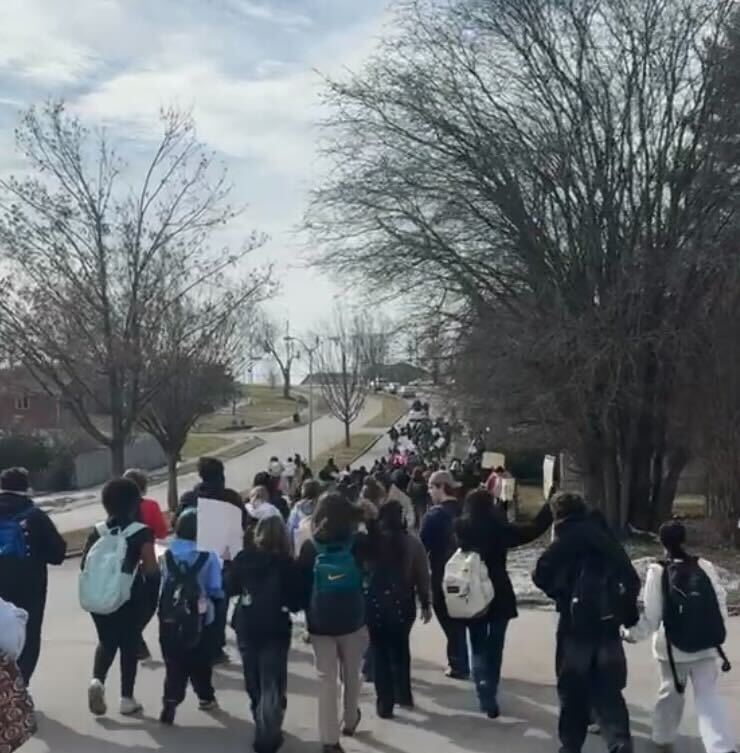
Throughout 2026 so far, communities across the country have protested. Thousands of students in Pennsylvania, Washington State, Texas, Indiana, Minnesota, and California, among many other states, organized walkouts in protest of ICE. Kentucky was no exception, with many students walking out.
Kentucky’s students are just as much of a stakeholder in this issue as any other group. Our schools, communities, and cities are only made stronger by the immigrants within them. In the early weeks of February, teenagers across the state organized a series of walkouts to show their dissatisfaction, frustration, and outrage with the current administration’s enabling of ICE abuses. Below, students share their opinions on what it was like to put together, observe, and participate in the protests.
This conversation has been edited for length and clarity.
.jpg)
What has been your community's general reaction to national news surrounding ICE throughout the past several weeks and months?
Lucy: I live in Lexington, so we are a pretty blue city, and I go to Tates Creek. We did our walkout last Thursday, which also just so happened to be the day that I was taking my HOSA state exam, so I was in business clothes and heels—I walked a mile and a half in heels for the walkout. We walked all the way up to the church that's right down the street from Tates Creek. We were getting so many supportive honks, and people were cheering from their cars. We had some adults join us at one point. On the opposite side, the police officers were not having it. They had their maces out, they were following us. Nobody was doing anything bad, but they were really not having it.
My school has about 2,000-ish students, and I think we had about 400 or 500 walk out, which was pretty good. That was the unapproved one. We did one at 1:40 p.m., and then there was a school-approved one at 3 p.m. Maybe 100 students showed up to the 3 p.m. one. Personally, it makes me so sick and so upset to see the videos of ICE and people being attacked or killed by ICE, and it just really, really, really, really upsets me.
Maggie: I would agree that there's just been a lot of anger, a lot of fear, concerning these events. On Instagram a lot, people will post ICE spottings that they see in Louisville. We have a really diverse community here. We have a lot of very strong communities that are made up heavily of immigrants—that’s a very, very big part of what our city is. There’s a lot of concern among people that I know, [and] classmates I have; that they could be in danger, their familiescould be in danger, things that are really bad could happen.
I was an organizer of my school's walkout. We definitely had a really great turnout for my school, and there was a lot of support for it. I feel like a lot of the people I know and a lot of people in my community are very much on the same page about what we want to see done about the issue of ICE and how we feel about what's been happening.
Hattie: I go to Rowan County Senior High School. I don't want to detract at all from other people's experiences, but for me personally, where I live in the state, I don't see a lot of people talking about it in person, unless [it is] maybe private conversations. There's very few attempts to organize a walkout or attempts to bring school-wide awareness or more publicized views of it. I'll see things posted online; people will post some stuff on their Instagram stories, but there's very little in-person backlash that is organized or widespread.
Last year, we had a situation within our own school that there was a walkout organized for, concerning one of the staff members. When that walkout was organized, it was very discouraged last year. I wonder if that has discouraged, maybe, a walkout about an issue like this, because there really has not been much push to do that. So, it makes you wonder the impact that the school's reaction to such things has on future organizations of walkouts and protests.
Ezra: There were a lot of in-person talks at my school, but I think following the line of folks...sometimes, they express their views online. What I've understood is that the organizers of the walkout sort of were just like, okay, we're gonna do this protest, and bam, we did it! That’s not how activism works. These walkouts, while they do something, they don't do a lot. They show solidarity, they show awareness, but they don't do a lot, and what I mean by a lot is continued activism. If you're doing something continued, then you're really putting in the effort. If you're doing this once or twice, then that's activism, that's a different flavor of activism, but you're not done, the job isn't done. I think it's interesting to look at how we can continue this activism, because it's not the end. I did end up actually participating, but where I was on the fence [is] because I would like to see continued efforts.
Maggie: The day that we did our walkout, we had a meeting for Philosophy Club, which is a club that I'm an officer for. We talked about the effectiveness of walkouts and the effectiveness of these single-time demonstrations. I definitely think it is a conversation to be had of, what is the most effective form of activism, and how can your actions be genuinely impactful?
I think it's hard, because as young people, we are very, very limited in what we can do, and in the power that we can have. I think that just demonstrating what we want and expressing what we want—we can’t do that through voting; we're in school, we can't drive, we can't go to the Capitol to go do testimonies on bills. The traditional routes of civic participation just aren't available to us, so that's why I feel like demonstrations and protests are so important for young people to be participating in.
I was actually also part of organizing a walkout against gun violence after the Annunciation Catholic school shooting. Afterwards, we got an op-ed published in our paper. We were reaching out to legislators following it. We were trying to get responses from people in power. I think that that is a very good way to follow up on a demonstration.
However, I do think with the ICE walkout specifically, I think that their occurrences at all…they already carry a lot of power, just because they're happening in so many places. The point of them is to be in solidarity with each other, and to show our legislators that we all want this thing gone, and we are all expressing that right now, and we are young people doing that. I think that because it is a nationwide thing, I think that it is still, like, very impactful. Demonstrations like this, I feel like, have been shown to be effective historically. Even in Minnesota, there have been so many just individual protests and individual demonstrations [that] groups [have] organized, and it has resulted in the withdrawal of thousands of agents from the city. There are still a lot of ICE agents who are still present there. I think that even a large movement like this, even if it is something that burns bright and fast, I think can still be very impactful.
Jayley: Where I live, we haven't had anybody do walkouts at all, just because I live in more of a rural area. But I think it's really cool to see online. Obviously it's not going to change everything just by doing a walkout, but I think it's cool that people show their solidarity in that way. They don't let whatever their staff members are saying to them, or anything like that, restrict them from showing their solidarity. I think it's inspiring, almost.
Innaree: I kind of disagree with that walkouts aren't doing anything. If we do walkouts, it’s going bring awareness to whatever is happening in Lexington. Some of my friends, for example, or [schools that had] unsuccessful walkouts, they said that most people who did not want to walk out with them kind of thought that the walkouts were useless, and that they didn't want to get in trouble for it. I felt the need to say that the whole point of a protest and a walkout is to describe your rights, and also to push away the standards of, I'm gonna follow the rules. Because you're walking for something that you believe in.
Lucy: At my school, it was really, really divided. We have such a diverse group of individuals, and my school is at least half minority at least. But we also have a Turning Point [chapter] at my school. So, some of the teachers, depending on what class you were in [during] 4th block, wrote their students up for skipping. Some people got referrals, and others didn't, and I felt like that is just so messed up. We went to our principal and we were like, dude, you have to waive those referrals just because a teacher is MAGA, or they support ICE doesn't mean their student should have a referral for speaking up for what they believe in. But we got all of the referrals waived, thank goodness.
Riess: So, my school tried to organize a walkout. It was very last-minute, and not very successful. We didn't have, like, posters or anything, really. It was kind of just an Instagram account was created. It did stir up a lot of talk. A lot of people were just talking about wanting to get out of class for it and whatnot, but it was supposed to happen between the transition of 5th and 6th period. Later found out they weren't even letting people out.
My APUSH teacher, who was my 6th period, was talking about it, and I thought it was very insightful. He was talking about throughout history, with past protests and peaceful protests, and civil rights activists in the past, some of the reasons that they were considered brave or courageous, like Rosa Parks [or] Martin Luther King Jr, is because they spoke out, even though they knew there were going to be consequences.
I just thought it was a really good point for him to make, because he was talking about how some kids were upset about getting tardies or facing the consequences for walking out if they were going to participate, and he basically was just saying, if you want to stand up for that, that is a really brave and courageous thing—speaking out what you believe in—but you do have to be prepared to face those consequences.
So, I just thought it was a good thing for people to consider. What's actually making a difference is you choosing to kind of…peacefully break the rules to speak out, and I think that's what makes it a big deal, when they're organized successfully. Sometimes you do have to face consequences in order to make change.
If you did have a walkout at your school, how was the organization of that happening? How was it planned?
Lucy: At my school, we had a group of 10 students, including me, who started organizing our walkout. We had two freshmen, four sophomores, two juniors, and three seniors. We had to get people from every grade level. We made online posters with Canva, and people posted them on their TikTok stories, their Instagram stories. We had an Instagram account, we had videos made.
There was nothing in person, because we were a little bit worrisome that the teachers would shut it down or something if we were handing out paper flyers. We got a really, really good outreach with social media, because, obviously, high schoolers are always on social media. So, everybody was viewing the stories, everybody was watching the videos, and they were telling their friends, and they were telling their friends, and so on and so forth. So that's how we got such a good turnout at my school.
Maggie: I'm part of a group called Sunrise, which is basically a club that's focused on environmental and wider social justice action planning for young people. I just kind of brought it to the other officers. We had a week to lock and make everything happen. We definitely were utilizing Instagram mostly to get the message out. We did some flyering. In school, we put up posters in the bathrooms. We did get this principal approved. We went to our principal, and we're like, we want to do this walkout; will you be behind us for this? And he was in approval of it.
Then we ended up getting in trouble for [flyering], because we just have a strict poster placement policy at our school. I'm just going to reiterate what my principal told me: he was like, even though administratively, we could do the walkout, they did not endorse the political opinion of the walkout, right? Because it's a public school; they can't do that. So, because of the way our poster policy is, every poster has to be approved. They couldn’t approve the poster. That would be an endorsement. Condoning the event would not be an endorsement, but the posters for it would be.
We didn't walk anywhere, actually, we just went into our courtyard. I organized a bunch of kids who really wanted to give speeches and talk. We had representatives from our Immigrant and Refugee Assistance Program Club, we had representatives from our LAHSO Club, which is basically [the] Hispanic Student Union. People were really excited about it.
Ezra: I don't think it was very well organized [at my school], but I will admit that it was pretty high turnout, which is great. They kept sort of flip-flopping over Instagram [about] what day they would do it, because I think they were trying to bend the snow days to their will. I don't think they had a very good hold over the logistics. I think if we just set a date that was a little bit in the future, it probably could have picked up more steam, although it definitely was a large demonstration.
Have any teachers or administrators at your school addressed the walkout, or have they addressed issues surrounding ICE in general in class?
Hattie: I've heard of maybe small discussions within private groups of students and whatnot, but I've not heard a single peep from any teachers, administrators, anything, about ICE. Because there haven't really been any walkouts or protests or anything for them to talk about, and I don't know if it's just…they don't want to get involved with politics or bring that up. But not even in history classes. It's just been really radio silence in terms of that during this time. I haven't heard anything from any teachers.
Jayley: It would be kind of taboo to talk about something like that, because of where I go to school. In my AP World class, specifically, though—I take Modern World History—my teacher really doesn't say his political opinions on stuff. But we have lots of debates in there to go along with our lesson plan. He likes to lead the discussion in a way where he doesn't really say if he's on one side or the other. But no matter what you say, he kind of plays devil's advocate with it, and really makes you think about what you're saying and how you're thinking.
Which, I feel like is kind of cool, because that's the one place in that whole school where we can really talk about what we believe in. That stuff doesn't really happen anywhere else in my school, in any other classes, except for that one class, specifically. I think that's cool. Although I think it's kind of odd that it's so taboo to talk about stuff like that in my school, even though it's such a big issue in the real world, and part of the problem is that people are not talking about it. I like the way that he's handling it, I guess in a way where he feels like he wouldn't get in trouble, but he wants to really make us think about everything we're saying, whether he agrees with it or not.
Lucy: My history teacher is actually the exact same. He refuses to tell how he feels about things. We were talking about the walkout, and he was like, I'm not saying it's good or bad, but if you're going to the walkout… They're really not allowed to say what they believe, but my biology teacher does, she doesn't care. She will speak up, and I love her so much. And my AP Gov teacher from last year, she's also very vocal about what she thinks. I still talk to her all the time. Individual groups of students will talk about it. Our friends, we are very vocal about what we think. And then there's the opposite, there's the students that refuse to say anything at all, because you can tell who they support.
Innaree: I go to Bluegrass Community College, during the day. I never go to my real [high] school. We only have four teachers there, so most of them haven't said a word, politics-wise. So the answer is no, but one person, she's a humanities teacher—I guess she is vocal about it. [But] they don't speak out on politics as much, and we have more freedom than other people in high school because we can talk about anything, [and] we won't get in trouble for it, but the teachers just don't choose to, I think. Or am I wrong about that?
Luisa: I go to a very conservative school…When we got to the topic of ICE [in class], I basically made the input— and I shouldn't have, but I did— of people should be using their white privilege to go out and protest, because they're less likely to be deported than Black and brown people. Students basically turned on me, saying I was racist to white people, and white privilege is not a thing, and all of that.
Flashback to now: Senior Assassin is coming up, and one of the groups literally titled themselves “Deportation Station,” and no one batted an eye, and no one gasps, no one cares. I am very grateful for people at schools like Fayette County, or in Louisville, who are doing walkouts, because I would love to join if the culture in my school was not as conservative. I definitely hope that students keep pushing and keep fighting.
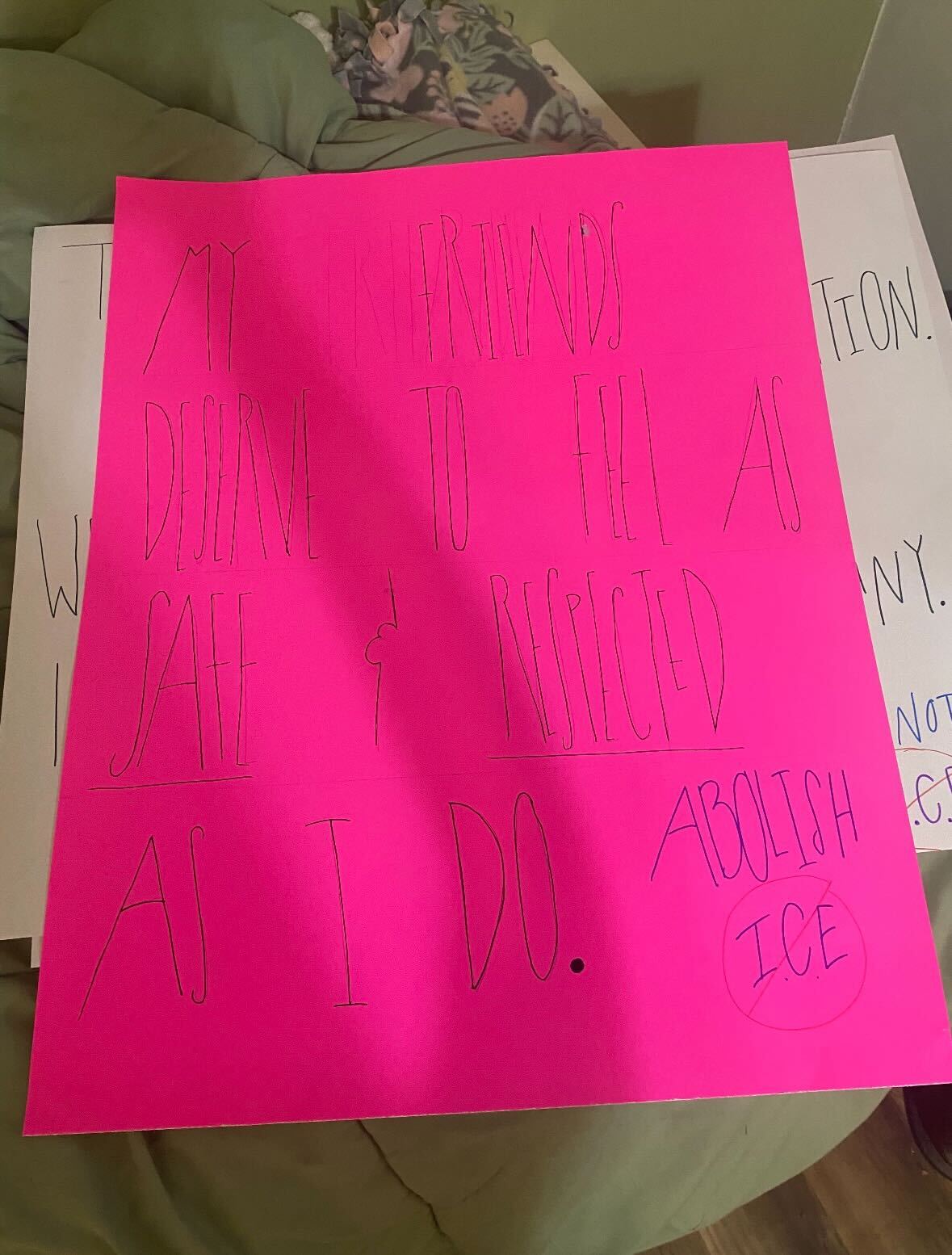
What have you been seeing online specifically, and do you think that online posting is effective in making any sort of difference?
Hattie: I don't know how effective it is, but I know that there are a lot of people posting on both sides of the spectrum. I've seen people posting, “join ICE today,” and I've seen people posting about awful things that are happening out on the streets, like in Minnesota and places like that.
I've had people reply to a story I post on Instagram, and call me out for what I've posted, and gotten into an argument with them, stuff like that. I try not to start up unnecessary beef with people or whatever, but I've definitely had people be angry about things I've posted, and I've seen people get angry about things each other have posted. I think the culture online is a lot more heated than it is in person. I think people are a lot more willing to state their opinions online than they are in person.
Innaree: I agree; it’s a lot is more heated online, and I feel like a lot of people are in this groupthink situation. Groupthink is basically where, if you're in this kind of friend group, or in this environment, and you believe in something.
I don't think walkouts are performative; I feel it's like you're actually doing something. But if it's—this can go for both sides, by the way– I feel that, like, if you don't know the actual affect and cause or any history behind whatever is happening right now, or what ICE is, and you're just posting stuff online and blurting out fake information you see on TikTok, I feel that is very performative, and it will have negative effects on people.
Ezra: These protests are inherently a performance. Not in a negative sense, but you are performing for the larger audience of your city, county, or your state, or your country. We are being performative always, and that's sort of the goal. We want to spread awareness. We want to be widely paid attention to as possible, like a performance might be. So I mean, I don't know, I guess it is performative, but I think only performative is negative if it isn't continued.
I think you could say the protest was performative. But again, a lot of folks are dipping their toes into activism, so I applaud their efforts regardless. I think we should be aware of continuing the effort, because ICE hasn't stopped doing degenerate things. They are only going to stop if either something internally happens, or I think people power, you know? I don't necessarily know, but that's the only thing they really can do, so continuing that effort is super important.
Lucy: I agree with you, Ezra. To those of you that follow me on Instagram, I know some of you do, I do have a lovely KSVT highlight where I post a lot of political things and things that I do for KSVT. And I get some replies to those. I get positive replies and negative replies. And it goes the same way for [a student who is] Turning Point leader. He also likes to post a lot of political stuff, but it's vastly different from mine, and he gets the same response. I feel like no matter what side you're on, you're going get pushback and support at the same time.




%20(1).jpg)